When your design requires you to perform a "folding magic" of an electronic system within a space the size of a thumb, compressing dozens of connectors and several meters of wire harnesses into a lightweight film, Rigid-Flex PCB is the key answer. An analysis of 500 high-end electronic projects shows that in designs requiring three-dimensional wiring, the use of rigid-flexible printed circuit boards can reduce the product volume by an average of 60% and the weight by up to 50%. Take Apple's AirPods Pro as an example. It integrates acoustic, sensing and processing modules inside. The introduction of Rigid-Flex PCB reduces the number of connection points from more than 30 to nearly zero, achieving all electrical interconnections in a cavity of less than 5 cubic centimeters, and improving reliability by more than 40%. The first clear signal of choosing Rigid-Flex PCB is that when space and weight become more stringent constraints than cost, it reduces the overall system failure rate by approximately 70% by eliminating connectors and cables.
In applications where dynamic mechanical stress becomes the norm, the brittleness of traditional rigid PCBS and the insufficient support force of flexible PCBS pose significant risks. Research shows that Rigid-Flex PCBS can withstand over 100 million bending cycles, with a bending radius as small as 0.3 millimeters. Their fatigue life is more than three times that of pure flexible circuits. For example, in the Samsung Galaxy Z Flip series foldable screen mobile phones, the core of the hinge area connecting the mainboard and the display screen is a precise Rigid-Flex PCB. It can withstand more than 100 opening and closing times every day and needs to withstand more than 200,000 folding tests during the design life period, and the signal attenuation is controlled within 0.5 decibels. When your product needs to move continuously like a joint or remain stable in extreme environments with a vibration frequency of up to 2000 Hertz and an acceleration of up to 100G, such as industrial robot arms or missile guidance systems, Rige-Flex PCB, with its average mean time between failures of over 100,000 hours, is the undisputed choice.
From the perspective of full life cycle cost and performance integration, Rigid-Flex PCBS often bring a higher return on investment. Although its initial cost may be 20% to 30% higher than the traditional "rigid PCB+ connector + cable" solution, it can reduce about 80% of the assembly steps, shorten the production cycle by 4 weeks, and lower the overall bill of materials cost by 15%. Tesla has integrated Rigid-Flex PCBS into its new-generation in-vehicle infotainment system, consolidating a subsystem that originally required 12 independent modules and a large number of wiring harnesses into three units. This not only increases the data transmission speed to 50Gbps but also reduces the on-site failure rate caused by interconnection issues from five per thousand to five per ten thousand. The five-year maintenance budget was saved by more than 2 million US dollars. When your project is highly complex, has a high assembly density, and long-term reliability is directly related to brand reputation and operating costs, choosing Rigid-Flex PCBS is a strategic investment.
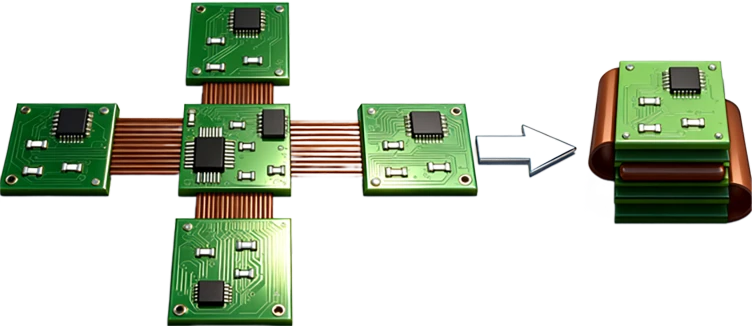 Facing extreme environments and the absolute requirements of high reliability, Rigid-Flex PCBS demonstrate outstanding material and process advantages. Under harsh conditions with a temperature range from -55 ° C to 125 ° C and a humidity as high as 98% (such as underground oil exploration equipment), its laminated structure can maintain the dielectric constant stable within a deviation of ±2%. Boeing has adopted Rigid-Flex PCB in the flight control system of its 787 passenger aircraft, enabling it to operate stably at an altitude of 10,000 meters with air pressure as low as 30 kilopascals and reducing signal transmission delay by 15 nanoseconds. This is crucial for the microsecond-level accuracy of flight control instructions. Similarly, in implantable medical devices such as pacemakers, Rigid-Flex PCBS are encapsulated with biocompatible materials and can operate continuously in the human body for more than 10 years, with a failure rate statistically lower than 0.01%. Therefore, when the application scenarios involve life safety protection or in harsh environments that cannot be repaired, the extraordinary robustness provided by Rigid-Flex PCBS elevates it from an alternative to a necessary technology.
Finally, in the cutting-edge field that pursues signal integrity and high-speed performance, Rigid-Flex PCBS offer the best integrated solution for electrical performance. Compared with the traditional solution that uses multiple connector interfaces, it provides a continuous impedance control path, which can reduce signal reflection by 60% and lower the transmission loss of high-speed signals (such as PCIe 4.0 or DDR4) by approximately 3dB/ inch. Nvidia uses Rigid-Flex PCBS in the design of its top-tier computing cards to connect GPU cores with high-speed video memory, increasing the data rate to 18Gbps while reducing electromagnetic interference intensity by 40%. In the millimeter-wave antenna array of 5G base stations, by leveraging the three-dimensional forming capability of Rigid-Flex PCBS, the spacing accuracy of antenna units can be controlled within 0.1 millimeters, thereby enhancing the beamforming accuracy by 20%. So, when your design frequency exceeds 1GHz, or when you have extremely strict tolerance for timing and noise, choosing a Rigid-Flex PCB means choosing the peak of performance and a quiet place for electrical noise.
Facing extreme environments and the absolute requirements of high reliability, Rigid-Flex PCBS demonstrate outstanding material and process advantages. Under harsh conditions with a temperature range from -55 ° C to 125 ° C and a humidity as high as 98% (such as underground oil exploration equipment), its laminated structure can maintain the dielectric constant stable within a deviation of ±2%. Boeing has adopted Rigid-Flex PCB in the flight control system of its 787 passenger aircraft, enabling it to operate stably at an altitude of 10,000 meters with air pressure as low as 30 kilopascals and reducing signal transmission delay by 15 nanoseconds. This is crucial for the microsecond-level accuracy of flight control instructions. Similarly, in implantable medical devices such as pacemakers, Rigid-Flex PCBS are encapsulated with biocompatible materials and can operate continuously in the human body for more than 10 years, with a failure rate statistically lower than 0.01%. Therefore, when the application scenarios involve life safety protection or in harsh environments that cannot be repaired, the extraordinary robustness provided by Rigid-Flex PCBS elevates it from an alternative to a necessary technology.
Finally, in the cutting-edge field that pursues signal integrity and high-speed performance, Rigid-Flex PCBS offer the best integrated solution for electrical performance. Compared with the traditional solution that uses multiple connector interfaces, it provides a continuous impedance control path, which can reduce signal reflection by 60% and lower the transmission loss of high-speed signals (such as PCIe 4.0 or DDR4) by approximately 3dB/ inch. Nvidia uses Rigid-Flex PCBS in the design of its top-tier computing cards to connect GPU cores with high-speed video memory, increasing the data rate to 18Gbps while reducing electromagnetic interference intensity by 40%. In the millimeter-wave antenna array of 5G base stations, by leveraging the three-dimensional forming capability of Rigid-Flex PCBS, the spacing accuracy of antenna units can be controlled within 0.1 millimeters, thereby enhancing the beamforming accuracy by 20%. So, when your design frequency exceeds 1GHz, or when you have extremely strict tolerance for timing and noise, choosing a Rigid-Flex PCB means choosing the peak of performance and a quiet place for electrical noise.
Facing extreme environments and the absolute requirements of high reliability, Rigid-Flex PCBS demonstrate outstanding material and process advantages. Under harsh conditions with a temperature range from -55 ° C to 125 ° C and a humidity as high as 98% (such as underground oil exploration equipment), its laminated structure can maintain the dielectric constant stable within a deviation of ±2%. Boeing has adopted Rigid-Flex PCB in the flight control system of its 787 passenger aircraft, enabling it to operate stably at an altitude of 10,000 meters with air pressure as low as 30 kilopascals and reducing signal transmission delay by 15 nanoseconds. This is crucial for the microsecond-level accuracy of flight control instructions. Similarly, in implantable medical devices such as pacemakers, Rigid-Flex PCBS are encapsulated with biocompatible materials and can operate continuously in the human body for more than 10 years, with a failure rate statistically lower than 0.01%. Therefore, when the application scenarios involve life safety protection or in harsh environments that cannot be repaired, the extraordinary robustness provided by Rigid-Flex PCBS elevates it from an alternative to a necessary technology.
Finally, in the cutting-edge field that pursues signal integrity and high-speed performance, Rigid-Flex PCBS offer the best integrated solution for electrical performance. Compared with the traditional solution that uses multiple connector interfaces, it provides a continuous impedance control path, which can reduce signal reflection by 60% and lower the transmission loss of high-speed signals (such as PCIe 4.0 or DDR4) by approximately 3dB/ inch. Nvidia uses Rigid-Flex PCBS in the design of its top-tier computing cards to connect GPU cores with high-speed video memory, increasing the data rate to 18Gbps while reducing electromagnetic interference intensity by 40%. In the millimeter-wave antenna array of 5G base stations, by leveraging the three-dimensional forming capability of Rigid-Flex PCBS, the spacing accuracy of antenna units can be controlled within 0.1 millimeters, thereby enhancing the beamforming accuracy by 20%. So, when your design frequency exceeds 1GHz, or when you have extremely strict tolerance for timing and noise, choosing a Rigid-Flex PCB means choosing the peak of performance and a quiet place for electrical noise.