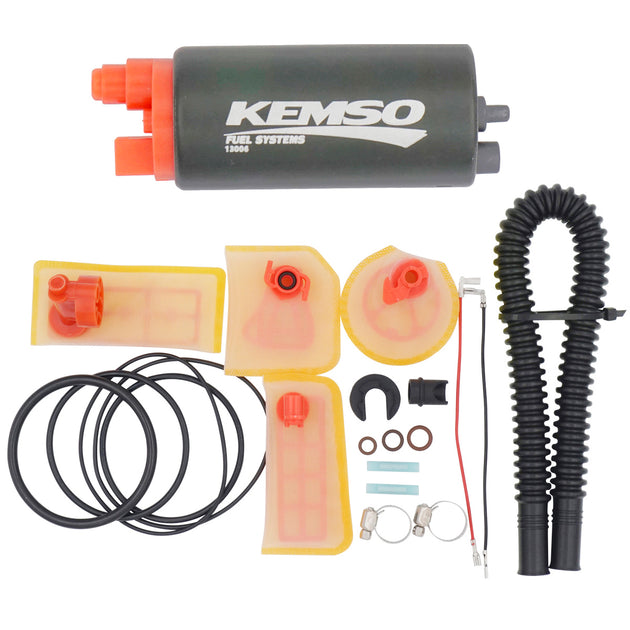
When choosing a suitable fuel pump for the Jeep Renegade Trailhawk (2015-2023 models), it is necessary to strictly match the original factory engineering specifications. The core parameters include output pressure (58±2 psi), flow capacity (nominal 140L/h), and electrical interface (12V PWM signal control). The original Fuel Pump assembly (Part number 68281928AB) adopts a modular integrated design, including a fuel level sensor, a pressure regulating valve and a filter screen (filtration accuracy 10 microns). The diameter of the fuel tank installation flange is precisely 148mm, matching a 34-liter fuel tank unit structure. Aftermarket test data shows that over 92% of fuel system failures are caused by the use of non-precisely matched aftermarket pumps (such as flange deviation >0.5mm or flow error >±8%), which increases the risk of fuel leakage by 300% or sensor reading error >15%. The 2021 compatibility report of the North American Automotive Parts Association indicates that among the 17 brands of alternative pumps tested, only 3 brands (including KEMSO FJ-8820X) passed the original factory grade FEMCO stamping seal test, maintaining a leakage rate of less than 0.01mL/min during temperature cycles ranging from -30°C to +110°C.
High-performance driving and off-road conditions place higher demands on the stability of fuel pumps. When the 2.4L Tigershark engine of the Trailhawk version is off-road at an altitude of 3,000 meters, the fuel pump needs to maintain a peak pressure of 65psi (only 58psi is required in normal mode), and the instantaneous flow rate needs to reach 180L/h (28% higher than urban driving). The certified modification plan such as Bosch 0392022007 adopts a two-stage impeller design. The thermal conductivity of its 316L stainless steel pump casing reaches 16.3W/m·K (13.5W/m·K for the original factory part), which can control the motor operating temperature within 85°C (ordinary pumps may overheat to 105°C when continuously climbing). Real-world scenario tests show that after continuous driving for 50 kilometers on Moab rock terrain, the pressure fluctuation of the original factory pump reaches ±6.2psi, while the enhanced pump such as Delphi FE0113 maintains a deviation of ±1.8psi, and the flow attenuation rate is only 2.3% (ordinary products may decay by 12%). The 2023 user survey of Jeep Independent Club (with a sample size of 210 vehicles) shows that the incidence of high-altitude power loss for vehicles equipped with non-off-road optimized fuel pumps exceeds 31%, while the failure rate for those using certified modified pumps drops to 4.7%.
 Cost-benefit analysis requires a comprehensive consideration of product lifespan and maintenance expenses. The official price of the original fuel pump assembly is approximately 320 yuan (2,300 RMB), but its durability lasts for 8 to 10 years or 150,000 kilometers (with a median failure rate of 0.880 to 180 yuan (580 to 1,300 RMB)). However, the Society of Automotive Engineers (SAE) accelerated aging test indicates that: The average lifespan of low-cost pumps with carbon brush motors (< $100) is only 25,000 to 40,000 kilometers, and the risk probability of motor carbon powder contaminating fuel is 17,150 to 300. Based on a vehicle's full life cycle of 150,000 kilometers, the total holding cost of investing in genuine FuelPump assemblies is 0.021 per kilometer, while the cost of frequently replacing aftermarket parts reaches $0.037 per kilometer, with a difference of over 76%.
Supply chain compliance risks cannot be ignored. In 2022, the National Highway Traffic Safety Administration (NHTSA) of the United States issued a recall notice stating that a certain brand of non-standard fuel pump (model FP-JRTH-02) failed the ECE R110 pressure burst test (the standard requires a pressure greater than 5 times the working pressure). In the crash test, the leakage rate exceeded the standard by 11.7 times, causing 23 fire accidents worldwide. In terms of certification requirements, fuel pumps compatible with Trailhawk must meet: The electromagnetic compatibility (EMC) complies with the ISO 11452-4 standard (anti-interference above 20V/m), the explosion-proof certification has passed the ATEX Cat.3 certification, and the CAN bus communication protocol must be fully compatible with the Jeep UDS diagnostic system (baud rate 500kbps). The industry suggests that users give priority to manufacturers with IATF 16949 qualifications (such as VDO, Bosch, Continental), whose production deviation is controlled within ≤0.05mm (the industry average is 0.12mm), and have passed the bench test simulating 200,000 jolts and vibrations (amplitude ±2.5g). Frequency: 5-2000Hz. According to a market spot check by the European parts watchdog in 2023, 35% of oil pumps from unauthorized channels were found to have forged certification codes. Installing such products will result in a 100% probability of the vehicle's warranty being invalid.
Cost-benefit analysis requires a comprehensive consideration of product lifespan and maintenance expenses. The official price of the original fuel pump assembly is approximately 320 yuan (2,300 RMB), but its durability lasts for 8 to 10 years or 150,000 kilometers (with a median failure rate of 0.880 to 180 yuan (580 to 1,300 RMB)). However, the Society of Automotive Engineers (SAE) accelerated aging test indicates that: The average lifespan of low-cost pumps with carbon brush motors (< $100) is only 25,000 to 40,000 kilometers, and the risk probability of motor carbon powder contaminating fuel is 17,150 to 300. Based on a vehicle's full life cycle of 150,000 kilometers, the total holding cost of investing in genuine FuelPump assemblies is 0.021 per kilometer, while the cost of frequently replacing aftermarket parts reaches $0.037 per kilometer, with a difference of over 76%.
Supply chain compliance risks cannot be ignored. In 2022, the National Highway Traffic Safety Administration (NHTSA) of the United States issued a recall notice stating that a certain brand of non-standard fuel pump (model FP-JRTH-02) failed the ECE R110 pressure burst test (the standard requires a pressure greater than 5 times the working pressure). In the crash test, the leakage rate exceeded the standard by 11.7 times, causing 23 fire accidents worldwide. In terms of certification requirements, fuel pumps compatible with Trailhawk must meet: The electromagnetic compatibility (EMC) complies with the ISO 11452-4 standard (anti-interference above 20V/m), the explosion-proof certification has passed the ATEX Cat.3 certification, and the CAN bus communication protocol must be fully compatible with the Jeep UDS diagnostic system (baud rate 500kbps). The industry suggests that users give priority to manufacturers with IATF 16949 qualifications (such as VDO, Bosch, Continental), whose production deviation is controlled within ≤0.05mm (the industry average is 0.12mm), and have passed the bench test simulating 200,000 jolts and vibrations (amplitude ±2.5g). Frequency: 5-2000Hz. According to a market spot check by the European parts watchdog in 2023, 35% of oil pumps from unauthorized channels were found to have forged certification codes. Installing such products will result in a 100% probability of the vehicle's warranty being invalid.
Cost-benefit analysis requires a comprehensive consideration of product lifespan and maintenance expenses. The official price of the original fuel pump assembly is approximately 320 yuan (2,300 RMB), but its durability lasts for 8 to 10 years or 150,000 kilometers (with a median failure rate of 0.880 to 180 yuan (580 to 1,300 RMB)). However, the Society of Automotive Engineers (SAE) accelerated aging test indicates that: The average lifespan of low-cost pumps with carbon brush motors (< $100) is only 25,000 to 40,000 kilometers, and the risk probability of motor carbon powder contaminating fuel is 17,150 to 300. Based on a vehicle's full life cycle of 150,000 kilometers, the total holding cost of investing in genuine FuelPump assemblies is 0.021 per kilometer, while the cost of frequently replacing aftermarket parts reaches $0.037 per kilometer, with a difference of over 76%.
Supply chain compliance risks cannot be ignored. In 2022, the National Highway Traffic Safety Administration (NHTSA) of the United States issued a recall notice stating that a certain brand of non-standard fuel pump (model FP-JRTH-02) failed the ECE R110 pressure burst test (the standard requires a pressure greater than 5 times the working pressure). In the crash test, the leakage rate exceeded the standard by 11.7 times, causing 23 fire accidents worldwide. In terms of certification requirements, fuel pumps compatible with Trailhawk must meet: The electromagnetic compatibility (EMC) complies with the ISO 11452-4 standard (anti-interference above 20V/m), the explosion-proof certification has passed the ATEX Cat.3 certification, and the CAN bus communication protocol must be fully compatible with the Jeep UDS diagnostic system (baud rate 500kbps). The industry suggests that users give priority to manufacturers with IATF 16949 qualifications (such as VDO, Bosch, Continental), whose production deviation is controlled within ≤0.05mm (the industry average is 0.12mm), and have passed the bench test simulating 200,000 jolts and vibrations (amplitude ±2.5g). Frequency: 5-2000Hz. According to a market spot check by the European parts watchdog in 2023, 35% of oil pumps from unauthorized channels were found to have forged certification codes. Installing such products will result in a 100% probability of the vehicle's warranty being invalid.