A Payback Period You Can Defend to a Business Partner
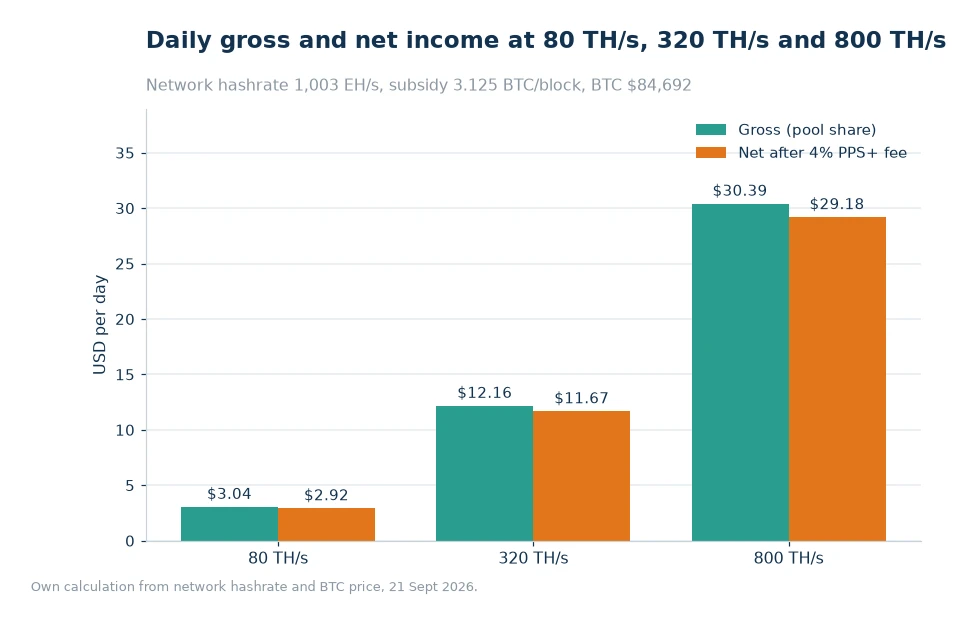
A partner will not accept "the machine pays for itself" as an answer, and they are right not to. At 80 TH/s the net credit is $2.92 a day, so a $2,000 machine takes 685 days to repay itself at today's difficulty — 761 days if the site only runs 90% of the time. Those two numbers are the start of a conversation, not the end of one.
Key takeaways
- 80 TH/s nets $2.92 a day, which repays a $2,000 machine in 685 days at full uptime.
- At 90% uptime the same repayment stretches to 761 days, before any difficulty change.
- 800 TH/s cuts the payback to 68.5 days, but the capital and the power bill scale with it.
- Quote the assumption behind every payback figure or the number is not auditable.
Equipment math and coin math are different ledgers
Coin math asks what a machine earns today. Equipment math asks whether the purchase beats the alternatives over its working life. The two use the same daily output figure but treat it differently: one treats it as income, the other as a repayment stream that has to survive difficulty changes, downtime and a resale value that falls with age.
A partner usually cares about the second ledger. They want to know how much capital goes out, how long until it returns and what happens if the return is slower than planned. Answering with the first ledger — "it earns $2.92 a day" — invites the obvious follow-up question, which is "for how long, and at what cost".
Separating the two also prevents a common error: treating the machine's entire daily output as profit. Power, cooling, pool fees and maintenance all come out of that figure before anything is repaid. The payback period should use the net number, after the listed fee and after the meter.
Choose the denominator before the numerator
The numerator is the capital cost, and it is easy: invoice price, shipping, import duty, the electrician's bill for a new circuit, the stand or enclosure. Most business cases understate this by leaving out the last three. The denominator is the daily net, and it is the number people fudge.
Use net, not gross. At 80 TH/s the gross is $3.04 and the net after the listed 4% is $2.92. Then subtract power. At 20 J/TH the machine draws 1.6 kW, which is 38.4 kWh a day; at $0.06 per kWh that is $2.30, leaving about $0.62 a day. The payback on a $2,000 machine becomes roughly 3,226 days, not 685.
That difference is the whole exercise. A business case built on gross output looks like a two-year payback; one built on net after power looks like nine years. The second is the one a partner can check against an electricity bill, and it is the one that should go in the document.
Treat the difficulty estimate as a sensitivity
Difficulty is the denominator's silent variable. The reading on 21 Sept 2026 put the next adjustment at an estimated −2.12%, which would raise output per terahash by about 2.17%. A rise of the same size would cut it by about 2.08%. Neither is a forecast; both are useful bounds for a sensitivity table.
Run the payback three ways: at today's difficulty, at 5% harder and at 10% harder. If the case only works in the first column, it is a bet on difficulty falling, and the partner should be told that in those words. If it survives the third, the purchase has room to absorb the normal drift of the network.
The ViaBTC Bitcoin Mining statistics pages publish the network numbers used in these calculations, which means the sensitivity table can be rebuilt by anyone reviewing the proposal. That matters more than elegance: an auditable assumption is easier to defend than a persuasive one.
Keep the page short enough to read in a meeting. One table of three difficulty scenarios, one line for uptime, one line for power and one line for the exit value covers the argument. Anything longer invites the reader to look for the assumption you buried, which is the opposite of what the document is for.
What to do when payback outlasts the warranty
Most mining hardware carries a warranty measured in months; a payback measured in years sits outside it. That mismatch is a risk, not a disqualification. The response is to plan for a repair reserve: set aside a percentage of monthly output, or price in one board replacement over the machine's life.
The second response is to shorten the exposure. Buying used hardware lowers the capital at risk and shortens the payback, at the cost of a shorter remaining life and no warranty. Buying new extends the life but raises the capital. Neither is universally right; the decision depends on how long the partner is willing to wait.
Write down an exit value. A machine that has run for two years is not worth its purchase price, and a business case that assumes it is has hidden a loss inside the payback period. Estimate the resale at half the purchase price and see whether the case still clears. If it does, the purchase is robust enough to survive an early exit.
| Hashrate | Daily net | Days to $2,000 | Days at 90% uptime |
|---|---|---|---|
| 80 TH/s | $2.92 | 684.9 | 761.0 |
| 320 TH/s | $11.67 | 171.4 | 190.4 |
| 800 TH/s | $29.18 | 68.5 | 76.2 |
Worked example
Build the 80 TH/s column from scratch, then see what the power line does to it.
- One terahash of capacity equals 450 ÷ 1,003,000,000, or 0.00000044865 BTC per day.
- At 80 TH/s: 80 × 0.00000044865 = 0.00003589 BTC a day.
- At $84,692: 0.00003589 × 84,692 = $3.039 gross.
- After the listed 4%: 3.039 × 0.96 = $2.918, or $2.92 net.
- Payback on $2,000 at the rounded net: 2,000 ÷ 2.92 = 684.9 days.
- At 90% uptime: 2.92 × 0.9 = $2.628 a day, so 2,000 ÷ 2.628 = 761.0 days.
- Power at 1.6 kW and $0.06 per kWh: 38.4 × 0.06 = $2.304 a day, leaving $0.616.
- Payback after power: 2,000 ÷ 0.616 = 3,247 days, which is the number the partner will ask about.
That last figure is uncomfortable, and it is the reason the conversation should include the power rate early. At a lower tariff the case changes completely; at a higher one it disappears. The machine is the same in every version.
Frequently asked questions
How long does an 80 TH/s machine take to pay for itself?
At $2.92 net a day, a $2,000 machine takes about 685 days at full uptime, or 761 days at 90% uptime. After electricity at $0.06 per kWh the figure stretches to several years, so the power rate decides the answer.
Should the payback calculation use gross or net output?
Net, after the listed fee and after power. Gross output overstates the repayment stream and produces a payback that cannot be reconciled with the electricity bill, which is the first thing a partner will check.
What difficulty assumption belongs in the proposal?
Show three: today's reading, 5% harder and 10% harder. A single-point estimate hides the risk, and a case that only works at today's difficulty should be described as a bet rather than a plan.
Sign the number before ordering the box
Put the payback, the uptime assumption, the power rate and the difficulty scenario on one page and have both partners initial it. The document is not a guarantee; it is a record of what was agreed, which is what makes a later shortfall a shared problem instead of an argument.
The Profit Calculator can regenerate the daily figure at any hashrate and difficulty, and the Statistics page supplies the network inputs. If the tool and the signed page disagree by more than rounding, the page is out of date and should be revised before the next purchase, not after it.
Sources: the ViaBTC homepage, calculator and statistics pages for network data and estimation[1]. Chain inputs from 21 Sept 2026: hashrate 1,003 EH/s, difficulty 132.76 T and BTC $84,692. Electricity is priced at 20 J/TH and $0.06 per kWh. Published 24 Oct 2026.